How SharpLine works, from zero.
This page assumes you have never placed a sports bet. Ten short sections take you from what odds mean to how we prove the edge is real. One worked example runs through all of it, and every number is checkable with our free calculators.
Same bet. Same risk. Different pay.
Two sportsbooks price the same team, in the same game, at the same moment. You risk $100 either way. Book A pays $84.75 if you win. Book B pays $92.59.
That is $7.84 more on the identical bet. Nothing about the game changed, only the price. Finding that difference systematically, across every book and every game, is the entire business.
Odds are probabilities wearing a costume.
American odds answer one question: how much do you win on $100? −118 means risk $118 to win $100. +109 means risk $100 to win $109. Every price also implies a win rate: the break-even point where the bet neither makes nor loses money. Bet at −118 and you need to win 54.1% of the time just to tread water.
The book charges a fee. It hides in the price.
Flip a fair coin: heads 50%, tails 50%. A sportsbook will quote both sides at −110, which implies 52.4% each. Add them up: 104.8%. Real probabilities sum to 100%. The extra 4.8% is the book's built-in fee, called the vig.
This is why the average bettor loses: every price on the board is quietly tilted against you before the game even starts.
Every measurement needs a ruler. Ours is Pinnacle.
To call a price wrong, you need a price you trust. Ours is Pinnacle, and the reasons are structural, not sentimental:
One honest caveat: Pinnacle is not an oracle. Its de-vigged price is the best available estimate of true probability, not a guarantee. Section 08 covers how we check that estimate against reality on every bet.
Strip the fee to find the fair price.
Pinnacle's quoted prices still contain Pinnacle's own vig. Three steps remove it. Here is our example game, worked end to end:
That 54.1%, the fair probability, and its price form of −118 are the ruler we measure every other book against. Check the arithmetic yourself with the de-vig calculator.
Paid as if 51.9%, when the truth is 54.1%.
Now line the two numbers up. The fair probability says your side wins 54.1% of the time. Book B's −108 price implies only 51.9%. The book is paying you as if the team wins less often than it really does. That gap has a dollar value, and it is called expected value, or EV.
You will lose often. That is the plan working.
A 54.1% win rate means losing 459 of every 1,000 bets, and losses cluster. Cold streaks are not the math failing; they are the math. Here are four simulated bankrolls making the same +4.2% EV bet 500 times:
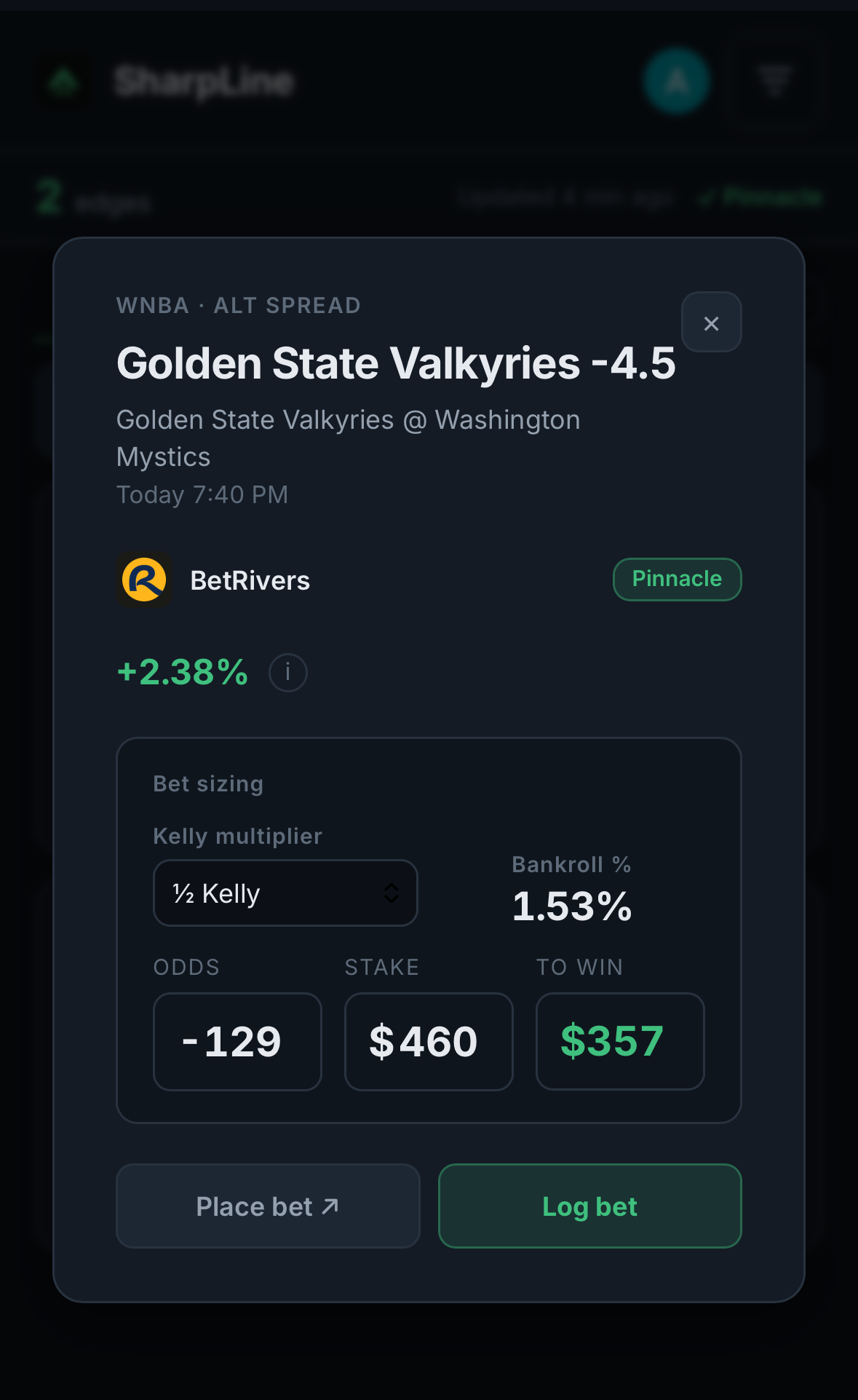
Surviving those swings is a bet-sizing problem. The Kelly criterion converts an edge into a stake size; full Kelly maximizes growth but swings violently, so SharpLine defaults to a quarter of it. For this edge on a $1,000 bankroll:
Every SharpLine bet card computes this for your bankroll and risk setting automatically. No gut instinct involved.
Beat the closing line and the edge was real.
Odds move as money and information arrive, and the last price before a game starts, the closing line, is the market's most accurate estimate. Any single bet can lose. But if the prices you take are consistently better than where the line closes, you had real edge. Results lag. The math does not.
SharpLine stamps closing line value on every logged bet automatically, so your edge is measured, not remembered. The public results on our homepage are scored the same way.
From scan to receipt, nothing on faith.
We can afford to show our work.
Most betting tools earn affiliate commissions for steering you to sportsbooks, which makes their incentives complicated. SharpLine takes no affiliate money from anyone. If the math on this page is wrong, we have nothing else to sell you. That is why all of it is public.
The calculators behind every number here are free and require no account: de-vig, expected value, Kelly stake, closing line value, and more. Run our numbers yourself. If they don't match, don't pay us.